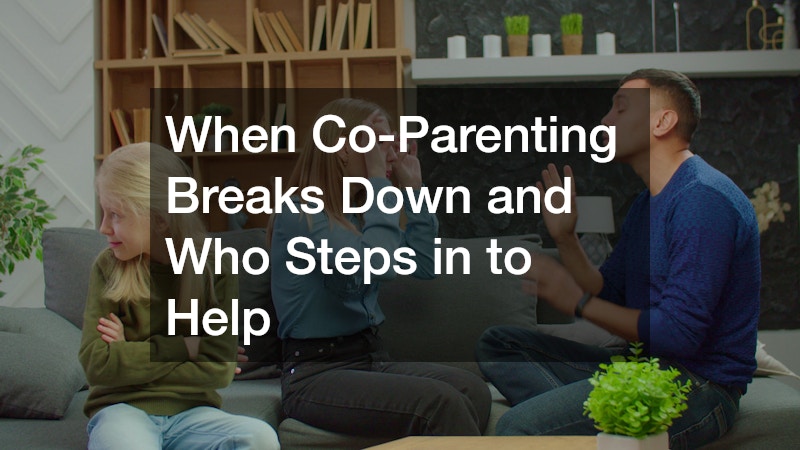

Co-parenting after a separation asks a lot of two people who may not agree on much anymore. When communication breaks down, missed custody exchanges, unpaid support, or safety concerns can turn an already difficult situation into a crisis. Knowing which professionals step in at each stage can help you protect your children and your own peace of mind. This guide walks through the common breakdown points and the specific help available when co-parenting stops working.
Recognizing the Early Warning Signs of a Breakdown

Co-parenting rarely collapses overnight. It typically starts with small cracks: one parent consistently late for pickups, texts left unanswered for days, or decisions about school and medical care made without consulting the other parent. On their own, these moments can seem minor or explainable, which is exactly why they’re easy to dismiss. Other warning signs are easy to overlook because they masquerade as normal parenting friction. A parent might start scheduling activities during the other’s custody time, or communicate exclusively through the children rather than directly with the co-parent. Conversations that once focused on the kids’ needs may shift toward keeping score, rehashing old grievances, or subtle digs about the other household. The frequency and pattern matter more than any single incident. A missed pickup due to a work emergency is different from three missed pickups in a month with no explanation. Watch for trends over a 30- to 60-day window: Is communication becoming shorter and more hostile? Are shared calendars or apps being ignored? Is one parent making unilateral choices about therapy, religion, or discipline that used to be joint decisions? Recognizing these patterns early gives you a chance to address them before they become entrenched habits that harm your children’s stability. The longer these behaviors go unaddressed, the more they calcify into “the new normal,” making eventual conversations about boundaries and expectations far harder to have.
- One parent making unilateral decisions on schooling, healthcare, or religion without consulting the other, even when a custody agreement requires joint input
- Repeated last-minute changes to custody schedules without discussion, forcing the other parent to rearrange work or plans on short notice
- Withholding information about the child’s activities, grades, medical appointments, or wellbeing, leaving one parent out of the loop entirely
- Using the children as messengers between parents instead of communicating directly, which puts kids in an uncomfortable middleman role
- Escalating arguments during exchanges that children witness, sometimes turning drop-offs or pickups into tense confrontations
- Frequent refusal to compromise on small logistical matters, like swapping a weekend or adjusting pickup times
- One parent badmouthing the other in front of the children or pressuring them to take sides
- A pattern of missed or late child support payments becoming a recurring source of conflict
Documenting Conflict Before It Escalates Further
When conflict becomes a pattern rather than an occasional bad day, documentation becomes your strongest tool. Keeping a simple log of missed exchanges, canceled visits, and communication breakdowns creates a factual record you can reference later. This isn’t about building a case against your co-parent for its own sake; it’s about having clarity when memories differ and emotions run high.
Many parents find it helpful to use a shared co-parenting app that timestamps messages and schedule changes automatically. These records often become useful if disputes eventually require outside intervention, since a clear timeline shows patterns rather than isolated incidents. Save texts, emails, and calendar confirmations rather than relying on verbal agreements.
Bringing in a Mediator Before Filing Anything Formal
Before turning to the court system, many parents try mediation, a process where a neutral third party helps both sides negotiate changes to custody or communication. Mediation tends to be faster and less expensive than litigation, and it keeps decision-making in the parents’ hands rather than a judge’s. It works best when both parents are willing to compromise and neither party feels unsafe in the other’s presence.
A good mediator will not take sides but will help identify what each parent actually needs versus what they’re demanding in the heat of an argument. Sessions often focus on practical fixes like adjusting pickup times, creating clearer holiday schedules, or setting communication rules. If mediation succeeds, the agreement can often be submitted to the court for approval, giving it legal weight without a drawn-out trial.
Involving Family Court When Agreements Break Down

When mediation fails or one parent refuses to participate in good faith, the next step is usually returning to family court. This is where family court attorneys become essential, since they understand how to file motions for contempt, request schedule modifications, or ask for enforcement of existing custody orders. An experienced attorney can also help you present documented patterns of noncompliance in a way that judges take seriously.
Family court attorneys typically guide parents through gathering evidence, preparing for hearings, and understanding what a judge is likely to prioritize, which is almost always the best interest of the child. They can also advise on realistic outcomes, since not every violation results in a major schedule overhaul. Having professional guidance reduces the chance of costly procedural mistakes that could delay resolution for months.
- Filing a motion for contempt when one parent repeatedly violates the order
- Requesting a formal modification of custody or visitation terms
- Seeking supervised visitation if safety concerns arise
- Enforcing child support payments through the court system
- Petitioning for a change in decision-making authority
Addressing Safety Concerns and Allegations of Abuse
Sometimes a co-parenting breakdown involves more than scheduling disputes or poor communication. If there are allegations of physical, emotional, or sexual abuse, the situation requires immediate and specialized attention. In these cases, sexual assault attorneys can help a parent understand how to report concerns properly, request emergency protective orders, and ensure that any investigation is handled with the sensitivity these cases demand.
These situations are emotionally charged and legally complex, so working with professionals experienced in abuse allegations matters enormously. They can coordinate with law enforcement, child protective services, and the family court simultaneously, which prevents conflicting actions across agencies. Parents should never attempt to handle serious safety allegations alone, since missteps in reporting or documentation can unintentionally weaken a legitimate concern.
Appealing a Custody Ruling You Believe Was Unjust
Occasionally a family court decision feels deeply unfair, whether because evidence was overlooked, a legal standard was misapplied, or the ruling doesn’t reflect the children’s actual best interests. In these situations, appellate attorneys step in to challenge the decision at a higher court level. Their work is different from trial attorneys, since appeals focus on legal errors in the original proceeding rather than presenting new evidence or retrying the facts.
Appeals are time-sensitive and procedurally strict, often requiring filing within a narrow window after the original ruling. Appellate attorneys review court transcripts, identify procedural mistakes, and build a written argument for why the decision should be reconsidered. While an appeal won’t guarantee a different outcome, it offers a legitimate path forward when a parent believes the original ruling was fundamentally flawed.
Co-parenting breakdowns rarely resolve themselves, but they don’t have to spiral into chaos either. Whether the fix is better documentation, mediation, formal court intervention, or specialized legal help for safety concerns, there’s a clear next step available at every stage. The most important move you can make right now is identifying where your situation falls on this spectrum and reaching out to the right professional before small problems become bigger ones. Your children’s stability depends on the decisions you make today, so don’t wait until the situation feels unmanageable to ask for help.